Design Tech Faculty
We want to explore how human beings are increasingly abstracted and deconstructed into compressible data structures within large-scale machine learning systems. In today’s digital landscape, our bodies and identities are no longer seen as whole, subjective beings. Instead, they are reduced by the internet and AI into visual fragments, labeled tokens, and statistical categories. For example, a face in a dataset is no longer tied to its owner. It becomes “Asian / female / smiling / tilted gaze,” a depersonalized unit optimized for pattern recognition and prediction.
This line of thinking raises the following questions:
What happens to our sense of self when human subjectivity is converted into machine-readable fragments?
How does annotation and labeling shape what is visible—and what becomes invisible or lost?
Can we design an experiential interface that reveals this transformation, not to critique it directly, but to expose what usually remains hidden?

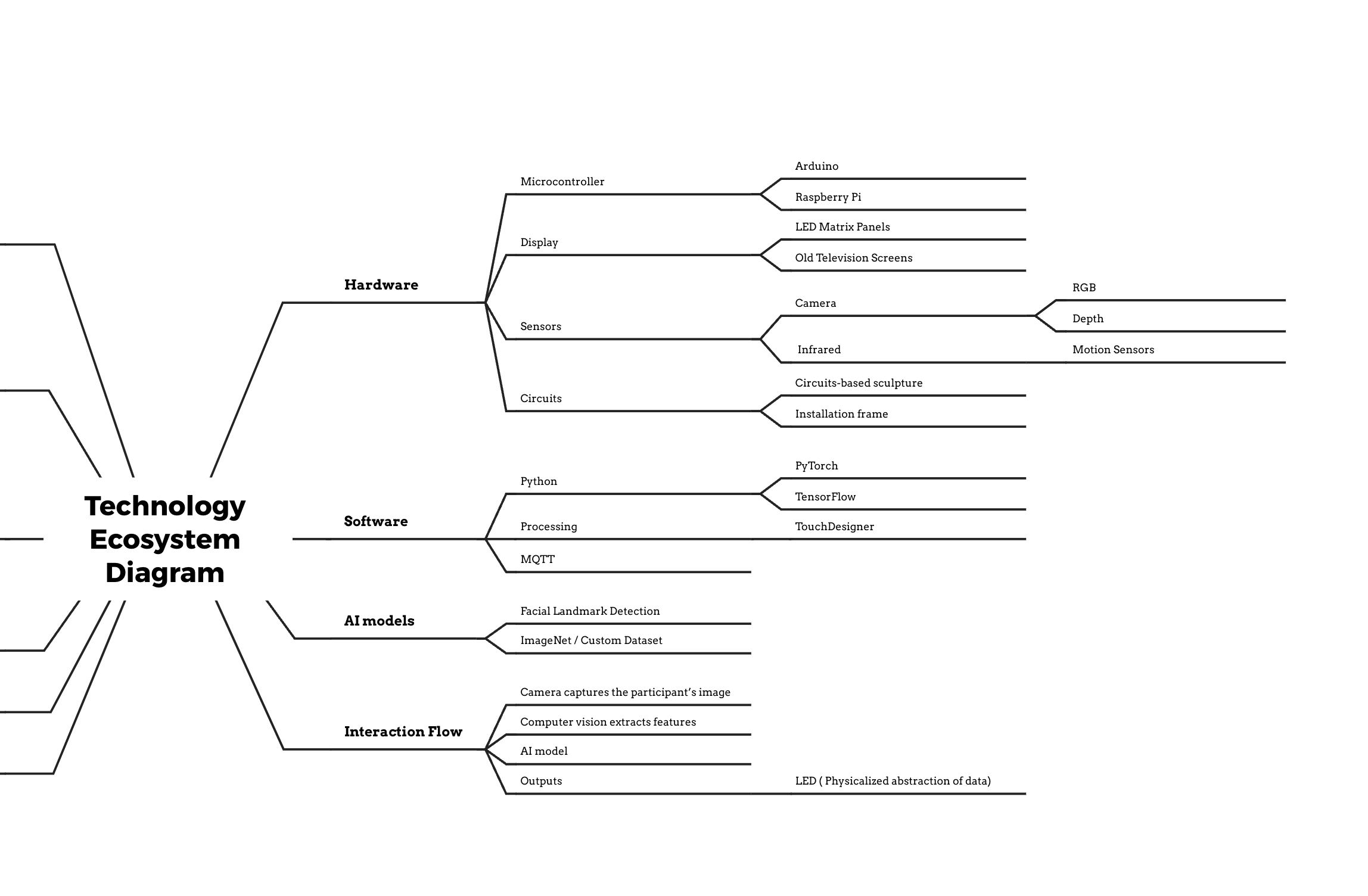
We aim to develop our practice at the intersection of generative AI, visual culture, and interactive design, with a particular focus on the physicalization of machine perception. This includes exploring how abstract AI processes can be made tangible through material systems such as circuits, sensors, and screen-based interfaces, and how identity, data, and embodiment can be reimagined through these hybrid forms.

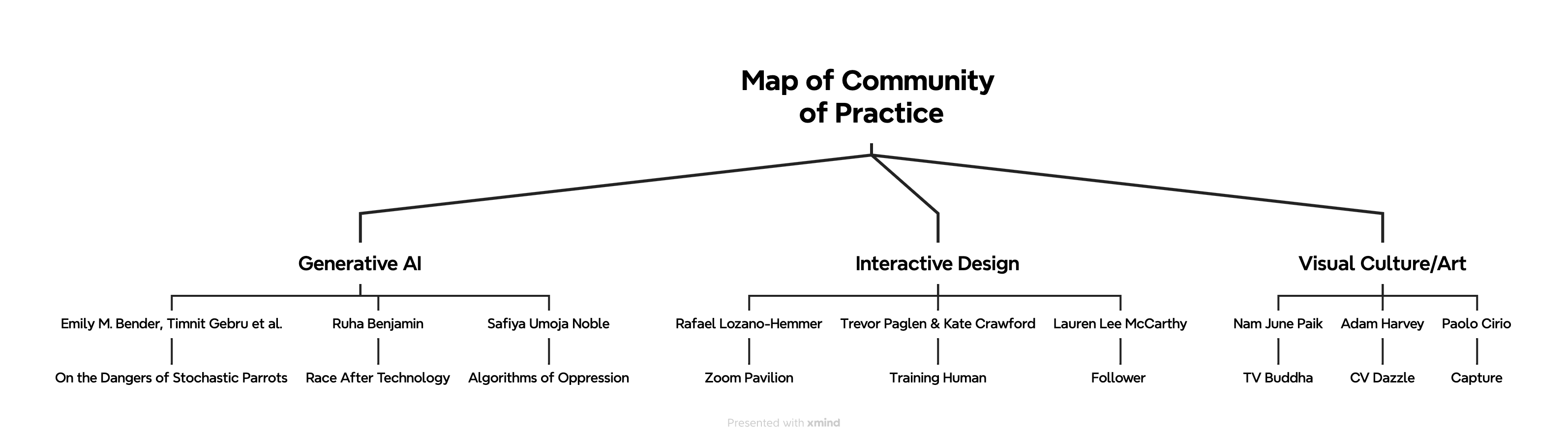
a.Textual & Media Analysis
Build a theoretical foundation around surveillance, datasets, and AI ethics by reading of key texts like Atlas of AI, Data Feminism (D’Ignazio & Klein)... Then visual analysis of datasets like ImageNet, MS-Celeb-1M ...to examine how human subjects are categorized and abstracted.
b. Dataset Ethnography
Trace the origins of an open-source dataset, examining collection methods, consent processes, and labeling guidelines. To get the first-hand insights into how human identity is deconstructed at the point of data creation.
After reading the magazines. In our view, a radical prototype is an open, participatory experiment in media. It is not just a single tool or device, but a living media ecosystem designed to center people and their interactions. Much like the Image Theater described in Radical Software (Volume 2, Issue 5), it functions as both a spatial and social experiment, where audiences are no longer passive spectators. Instead, the environment is deliberately designed to encourage dialogue and connection. For example, through seating arrangements that foster conversation and collective experience.
Beyond the audience space, that entire facility is organized as an integrated system for production, coordination, and distribution. This includes a control room for live mixing and special effects, as well as areas for editing, storage, and program sharing. In this way, the radical prototype creates a publicly accessible network of creation and feedback, challenging the top-down structures of media production.